

Economic Snapshot – October 2026
Economically, inflation persists at higher than desired levels, unemployment remains relatively low, but the persistent inflation and higher cash rates continue to suggest economic weakness is very possible over the next 12 months.

This October economic snapshot article is prepared by Michael Furey, Principal of Delta Research & Advisory, on behalf of the HPartners Group.
Summary
- Oil continued its upward trajectory during October placing increased inflationary pressure but this time it didn’t result in higher bond yields, as markets took advantage of the attractive yields and bought more, which resulted in lower yield … but they still present as a relatively appealing asset class if focused on the long-term.
- The best performing asset class (aside from energy) in October was Global Infrastructure and to a lesser degree listed property. This is because the lower bond yields provided some relief to these, usual, leveraged securities.
- Economically, inflation persists at higher than desired levels, unemployment remains relatively low, but the persistent inflation and higher cash rates continue to suggest economic weakness is very possible over the next 12 months. Newspaper talk is suggesting the possibility of recession in Australia during 2027, but market data shows few signs of this occurring.
- Our core investment message remains due to persistent downside risks from high sharemarket valuations in USA and the energy crisis. This means disciplined risk management rather than aggressive position changes. Shares continue to offer an attractive risk premium in specific markets, as do conservative bonds, but returns may be challenged from occasional short-term volatility. Avoiding panic (selling) decisions continues to be a crucial investment issue today for long-term investors.
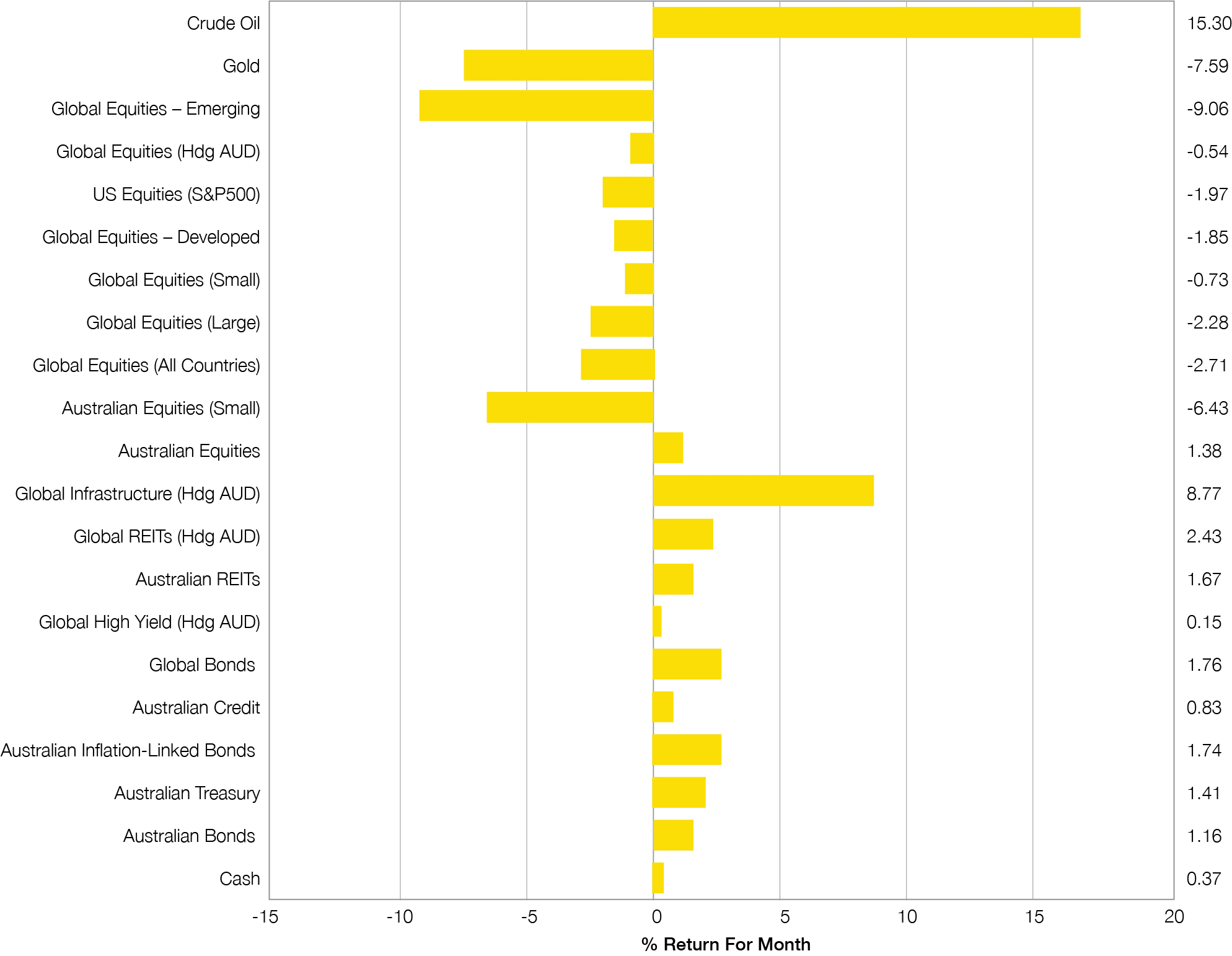
Chart 1
Higher bond yields… weak sharemarkets and even weaker real asset returns.
What Happened Last Month?
Markets & Economy
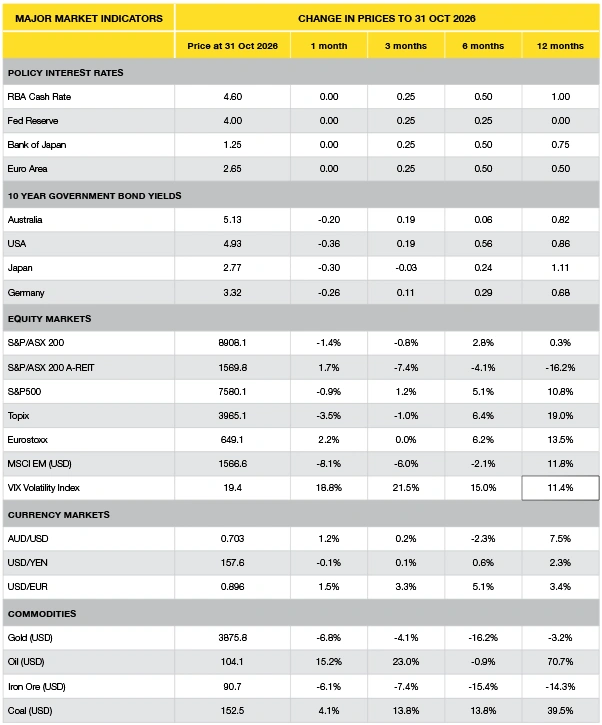
- After strong increases in bond yields and news headlines of bond disaster, yields declined around the world including Australia (10yr yield decreased 0.20%) and USA (10yr yield decreased 0.36%).
- These yield decreases provided the platform for strong returns from interest rate sensitive asset classes, such as Property and Infrastructure. As Chart 1 shows, Global Infrastructure increased almost 9%, whilst Global REITs produced a solid 2.4%.
- Whilst the broad Australian sharemarket increased a little over 1% in October, Australian small companies, Global developed and emerging markets all declined strongly. Australian small companies were down over 6%, the developed market, MSCI World, was down 2.3% whilst Emerging Markets declined a nasty 9%.
- Primary reasons for weaker global equity returns in October was a sell-off in AI-related stocks which impacts the larger companies in both developed markets (e.g. Nvidia), and Emerging Markets (e.g. Taiwan Semiconductor).
- Economic data during October continued the same theme with above-desired inflation, reasonably low unemployment levels, and subdued economic growth. Inflation pressure will reduce with the cessation of the Iran war and tariff policies of the USA … will USA Congress take back control of the funding and approval of these controversial policies.
Outlook
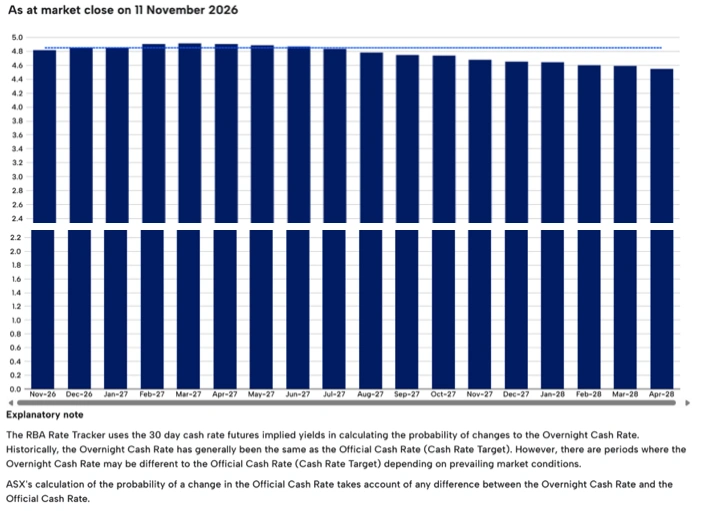
- The continuation of higher inflation in Australia keeps a strong likelihood of more rate increases and we now know the Melbourne Cup meeting resulted in another increase to 4.8% and the highest since around the GFC in 2008 … current markets suggest this is near the top but future inflation results will be the primary determinant.
- The continuing high bond yields make fixed interest and longer duration (or term to maturity) investments more appealing if focused on the long term. These expected returns suggest more than 5-6%pa over the next 5+ years.
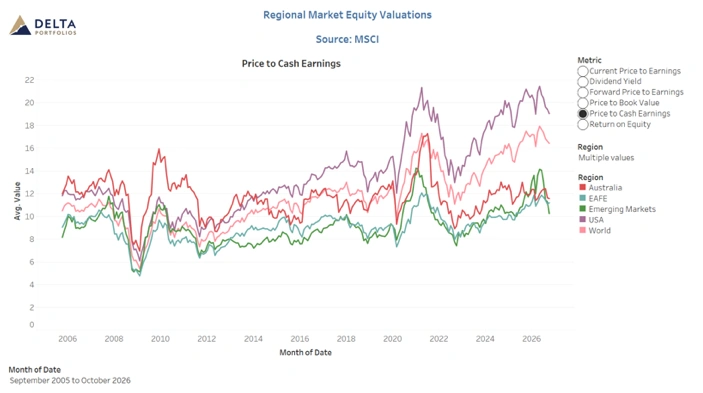
- Despite a small sell-off, US markets continue near record high valuations and are forecast to be weaker than non-USA sharemarkets over the next 10 years. As previously mentioned, this doesn’t mean any imminent crash is likely, and returns may continue to be good over the short-term, particularly whilst the AI capex has a long time to go yet, but caution should always be appropriate with expensive markets.
- Our core message remains as we continue to believe portfolios should be underweight USA shares and high yield (junk) bonds due to these near record high valuations. By comparison, defensive Cash and bond portfolios both global and in Australia, are providing strong relative expected returns at over 5%pa.
- Our current beliefs are that new investors should dollar cost average into sharemarkets and long-term investors should stay invested for the long-term but should expect and get used to higher volatility.
- Diversification continues to be essential. Maintaining a balance between domestic and global exposures remains a prudent approach as 2026 unfolds. Rebalancing as pricing opportunities arise also continues to be appropriate for established portfolios.
Major Market Indicators
Source: Morningstar, Trading Economics, Reserve Bank of Australia
30 September Market Valuations since 1969 – Price to Cash Earnings… contineud improvement in USA but still high
Markets suggesting the peak of cash rates may be here
Published:
Share


Resources
A wealth of knowledge
Latest News
-
Christmas Bonus Tax 2026: How Much Will You Keep?
 November 17, 2026
-
Economic Snapshot – October 2026
November 17, 2026
-
Best Black Friday Sales in 2026 (And How to Budget For Them)
November 3, 2026
-
Is Your Insurance Through Super Enough?
November 3, 2026
-
Early Super Withdrawals Soar as Dental Bills Bite
October 27, 2026
-
Gifting Money? Beware of Centrelink Gifting Rules
October 27, 2026

Tools & Guides
Useful tools & guides to get you started
 Find out more

Video Guides
Useful videos to get you started
Find out more

Financial Calculators
See what impact little changes can have
Find out more